Chevron and Herringbone LVT in Period Properties Across the East Midlands: Does It Work?
Herringbone LVT suits period properties beautifully. We explain why it works, how we fit it, and what to expect in older Newark and East Midlands homes.

Herringbone LVT in Period Properties: Why It Works So Well in Newark & the East Midlands
Older homes and herringbone flooring have always belonged together. The pattern has been laid in hallways, parlours and reception rooms for centuries, so when a Victorian terrace or an Edwardian semi gets a herringbone LVT floor, it does not look like a trend has been forced in. It looks like it was always meant to be there.
What has changed is the material. Luxury vinyl tile in a herringbone layout gives you the visual warmth of a wood-effect floor without the vulnerabilities that make real timber a gamble in older properties. That matters a great deal across Newark-on-Trent and the wider East Midlands, where a huge proportion of the housing stock pre-dates central heating, has solid rather than suspended floors, and carries the kind of ground-level moisture that quietly wrecks timber and laminate over time.
Why Herringbone and Period Properties Are Such a Natural Match
The geometry of herringbone is inherently traditional. It draws the eye along a room in a way that plank flooring simply does not, and in a hallway or a knocked-through Victorian reception room it creates a sense of depth and formality that feels entirely at home alongside original cornicing, picture rails and fireplaces.
That said, it is not just about aesthetics. Herringbone LVT in a glue-down format sits flat, tight and stable in a way that click-together plank LVT cannot always match in rooms where walls are not square and floor levels shift slightly from one side to the other. Period properties rarely have perfectly rectangular rooms. Glue-down herringbone LVT accommodates that reality far more gracefully.
What Makes LVT the Right Choice for Older Homes Specifically
Damp is the single biggest issue in older East Midlands properties. Solid brick construction, no cavity wall insulation and original solid concrete or stone floors mean moisture levels at floor level are often higher than they would be in a modern house. Laminate swells. Engineered hardwood can cup or gap. Real wood needs acclimatising carefully and still carries risk if conditions change.
LVT is dimensionally stable. It does not react to humidity in the way wood-based products do. Fitted over a properly prepared subfloor with a damp proof membrane where needed, it will hold its shape and its finish year after year regardless of what the ground beneath it is doing.
We always assess the subfloor before we recommend any product. If there is moisture present, we address it at that stage rather than fitting over it and hoping for the best. You can read more about why that preparation stage matters so much in our article on damp proof membranes and floor levelling in older Newark and East Midlands properties.
Does Herringbone LVT Actually Look Like Real Wood?
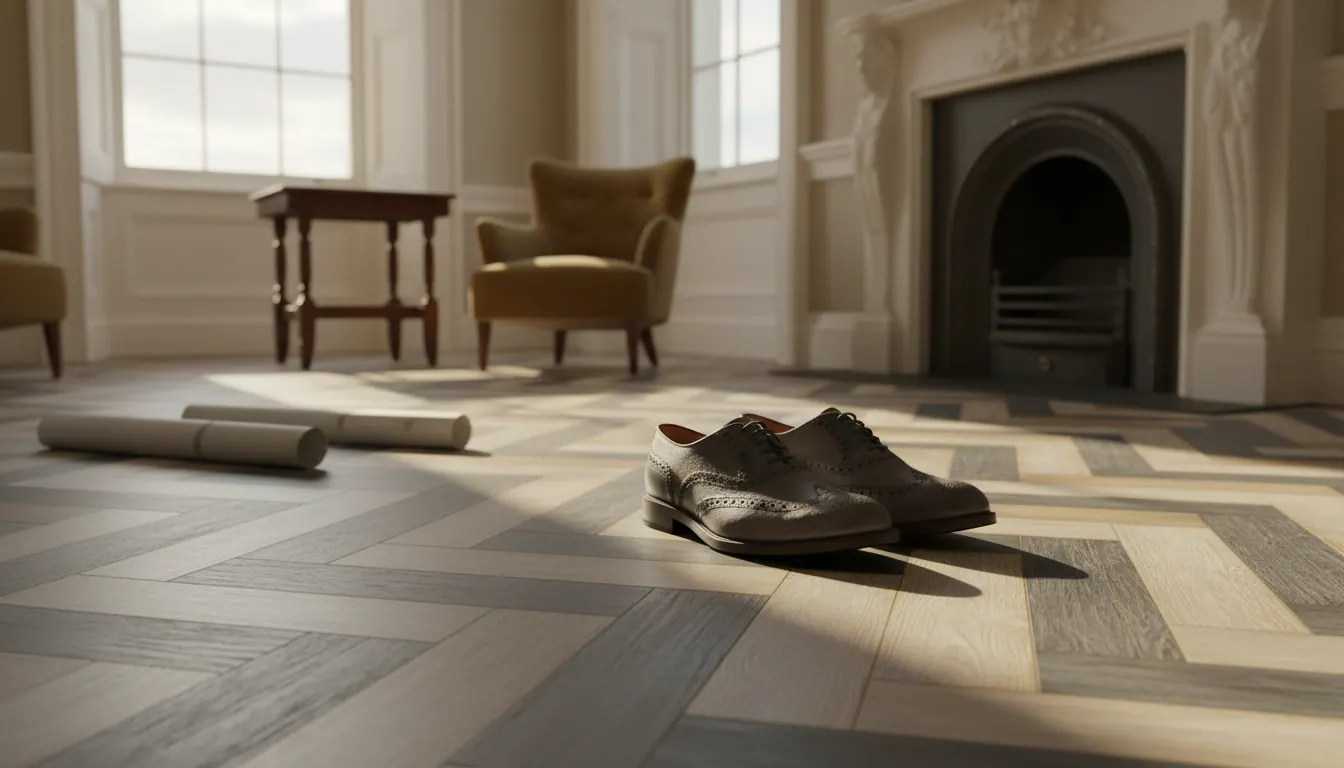
This is one of the questions we get asked most often, and the honest answer is: the better products are genuinely convincing. Modern wood-effect LVT is printed and embossed to replicate the grain, texture and colour variation of real timber, and in a herringbone layout the way the tiles interlock creates the kind of visual movement you associate with a parquet floor.
Light oak herringbone LVT is probably the most requested finish in period properties right now. It is warm without being heavy, and it works with both original features and more contemporary furniture. Wider plank herringbone in a mid or smoked oak tone suits slightly grander Victorian rooms where a lighter finish might feel out of scale.
We bring samples to your home so you can see the finish in your own light before committing. Showroom lighting tells you very little about how a floor will look in a north-facing parlour or a narrow hallway. Your own rooms do.
Glue-Down vs Click: Which Is Right for a Period Property?
For most period properties, glue-down herringbone LVT is our recommendation. Here is why.
- Stability. Glue-down tiles cannot shift, lift at the edges or develop movement over time. In a busy hallway or a kitchen-diner that sees heavy traffic, that matters.
- Profile. Glue-down LVT sits lower than a click system, which helps where door thresholds are already tight.
- Subfloor tolerance. Click LVT needs a very flat subfloor. Any ridge or dip telegraphs through the tile surface because there is nothing holding it down. LVT is thin, so every imperfection underneath shows. With glue-down, we can latex-screed the subfloor to a precise level first, then lay into adhesive for a finish that is genuinely flat.
- Pattern integrity. Herringbone relies on consistent geometry. Glue-down gives us the control to keep that geometry exact across the whole floor, even when walls are not quite square.
Click LVT has its place. For a rental property where speed of installation or future replacement matters, or for a room where the subfloor is already in good condition, it can be the right call. But for a period home where the floor is a design statement, glue-down is nearly always the better answer.
What to Expect From a Herringbone LVT Installation in a Period Home
The process is more involved than laying plank LVT, and it is worth understanding why.
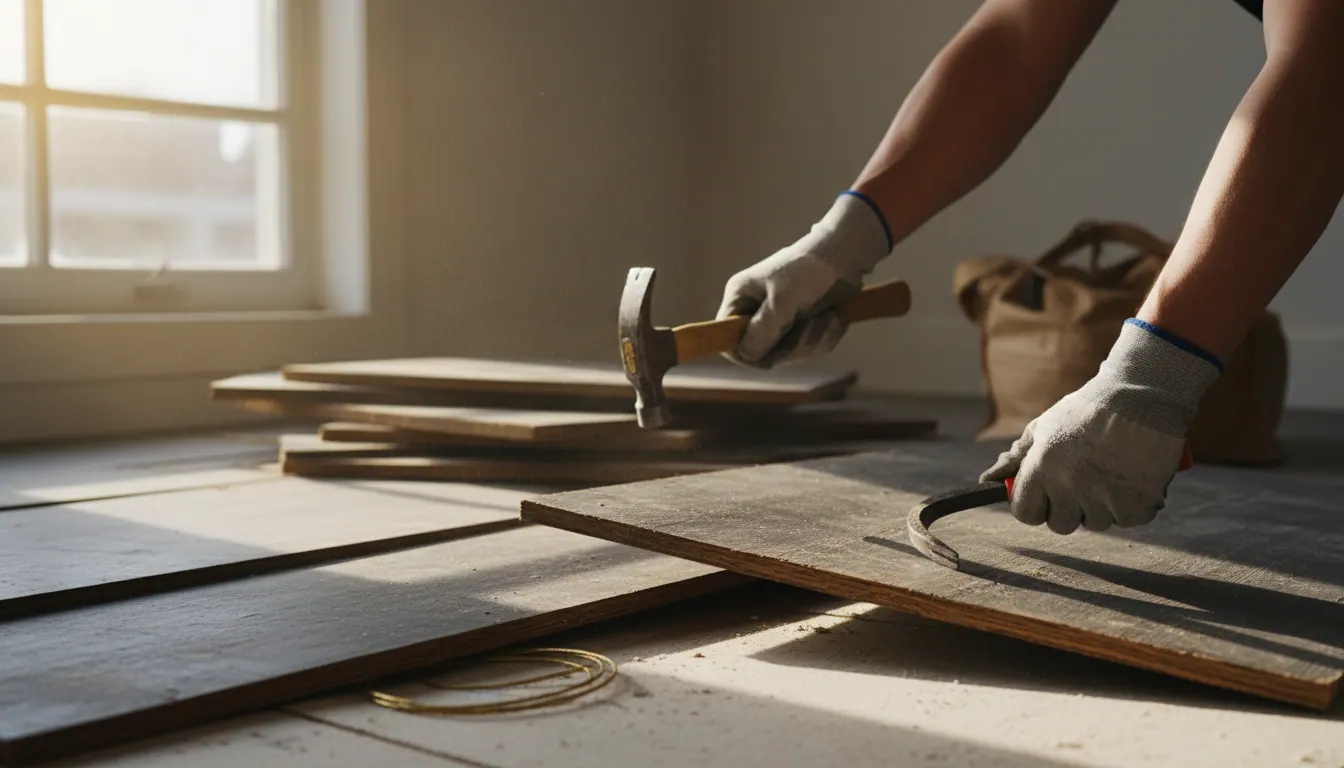
First, we lift and remove the existing floor covering. In older properties this sometimes means dealing with multiple layers of old vinyl, adhesive residue or original quarry tiles. We handle that and take it away. You can read more about what that stage involves in our guide to old flooring removal and disposal in Newark.
Then comes subfloor preparation. We assess the level, check for moisture, and apply latex screeding or a DPM where needed. This is not optional in a period property. It is the stage that determines whether the finished floor performs as it should.
Once the subfloor is ready, we set out the herringbone pattern from the centre of the room to ensure the cut tiles at the edges are balanced and symmetrical. In a hallway, the pattern is typically centred on the run of the space. In a square or near-square room, we work from the midpoint in both directions. The setting-out stage takes time, but it is what separates a floor that looks considered from one that looks rushed.
Will Herringbone LVT Date? And Is It Still Worth Choosing in 2026?
Herringbone as a pattern has been in continuous use since Roman mosaic floors. It did not date then and it will not date now. What does date is a particular colourway or finish that is very much of its moment. The pattern itself is as neutral as a brick bond.
The practical question is whether the specific product you choose will look as relevant in ten years as it does today. Our advice is to lean towards classic rather than fashionable. A light or mid oak wood-effect LVT in herringbone will age gracefully. A very grey, very cool-toned finish might feel more tied to a particular decade.
That said, LVT is not a permanent fixture in the way a tiled floor is. If your tastes change, it can be replaced. The subfloor preparation underneath is the investment that lasts. The floor covering on top of it can evolve.
What One of Our Customers Said
Jo came to us wanting a specific finish and a result that genuinely matched her vision for the room. This is what she said afterwards:
"Nathan was great, really helpful and supportive to help us achieve the finish we wanted and getting the best out of our budget. We got booked in really quick and were kept informed throughout the process. The fitting was done to a high standard amd we couldn't be happier with the finished result. Would 100% recommend."
, Jo Mansfield
That phrase "achieve the finish we wanted" is important to us. We are not here to push a particular product because it is convenient. We are here to understand what you are trying to do with your space and advise on the best way to get there.
Frequently Asked Questions
Is herringbone flooring going out of style? No. Herringbone is one of the oldest geometric patterns in flooring and it has never genuinely gone out of style. It has had periods of greater or lesser popularity, but in a period property it is always contextually appropriate. In 2026 it remains one of the most requested LVT layouts we fit.
When is herringbone LVT not the right choice? If a room is very small and narrow, a full herringbone layout can feel busy and may not give enough room for the pattern to read properly. In those cases, a simple plank LVT or a herringbone used as a feature strip rather than a field pattern can work better. We will tell you honestly if we think herringbone is not the right call for a particular space.
Does LVT last as long as real wood or tile? LVT is a durable product and, fitted correctly over a properly prepared subfloor, it will give many years of reliable service. The wear layer thickness is the key variable. Thicker wear layers suit higher-traffic areas. We will advise on the appropriate specification for each room. We do not make specific claims about longevity because that depends on the product, the preparation and how the floor is used.
Can herringbone LVT be fitted over underfloor heating in a period property? Yes, in most cases. LVT is generally compatible with underfloor heating systems, but the product specification and adhesive must be suitable for use with heat. We check compatibility before recommending any product for a heated subfloor.
Get in Touch
If you have a period property in Newark-on-Trent, Nottinghamshire, Lincolnshire or Leicestershire and you are thinking about herringbone LVT, we would be glad to come and look at the space with you. We bring samples to your home, assess the subfloor, and give you a clear picture of what is involved before you commit to anything.
Get in touch with us here and we will arrange a free home measure and quotation at a time that suits you, Monday to Friday.