Damp Proof Membranes & Floor Levelling: Why They're Essential in Older Newark & East Midlands Properties
Planning new flooring in Newark or the East Midlands? Here's why a damp proof membrane floor matters and how we install it properly.

Why a damp proof membrane floor matters more than most people realise
Concrete ground floors breathe. Not in a helpful way, but in a slow, relentless way that pushes moisture vapour upward through the slab and into whatever flooring sits on top. Most homeowners only discover this after the damage is done: LVT lifting at the edges, laminate boards swelling and buckling, carpet backing rotting from beneath. A damp proof membrane (DPM) is the layer that stops that from happening.
We carry out subfloor preparation across Newark-on-Trent, Nottinghamshire, Lincolnshire and Leicestershire, and damp-related subfloor problems are among the most common things we encounter, particularly in older bungalows, ground-floor extensions and period properties across the region. Getting the DPM right is not optional. It is the foundation everything else depends on.
What exactly is a damp proof membrane, and how does it work?
A damp proof membrane is a barrier, either a sheet or a liquid-applied coating, that sits between a concrete subfloor and the flooring above it. Its job is to block moisture vapour from rising through the slab and reaching the adhesive, underlay or flooring material above.
There are two main types we use in practice:
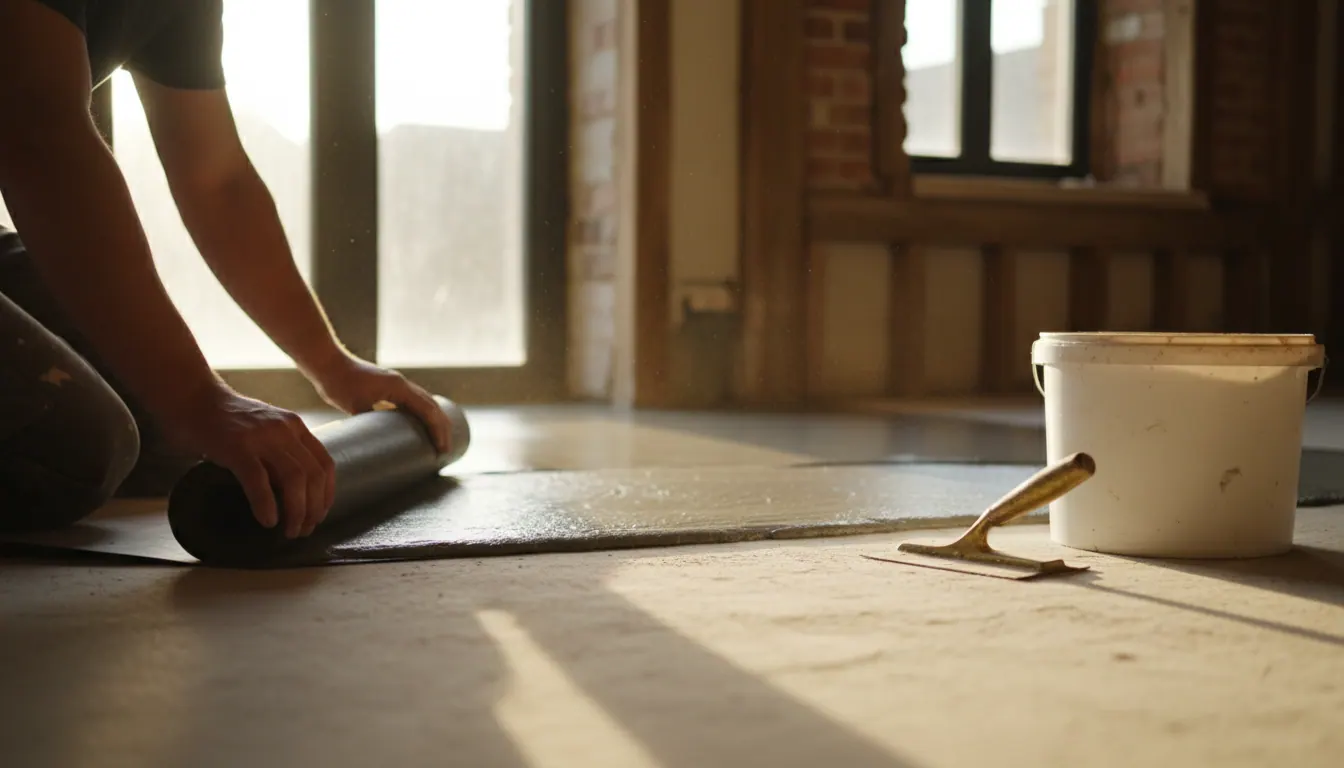
- Sheet DPM. A heavy-duty polyethylene sheet, typically 1200 gauge or heavier, laid across the concrete and lapped up the walls before being trimmed back once the floor finish is installed. It is the most common choice for a straightforward concrete floor where the slab is reasonably flat.
- Liquid DPM. A resin or epoxy-based product brushed or rolled directly onto the concrete surface. It cures to form a seamless, bonded barrier and is particularly useful where a sheet membrane would be awkward (around pipes, step changes or irregular shapes) or where the concrete needs to be bonded to a levelling compound directly on top.
Both work. The right choice depends on the condition of the slab, the flooring going on top, and what else the subfloor needs before the finish goes down.
Do damp proof membranes actually work?
Yes, when they are installed correctly. The failure mode is almost always in the detail: a sheet membrane with laps that are not sealed properly, a liquid DPM applied too thinly or over a dusty surface that prevents adhesion, or a membrane that stops short of the wall and leaves a gap for moisture to sneak around the edge.
Done properly, a DPM creates a continuous, sealed barrier. Moisture vapour cannot get through a fully bonded epoxy membrane or a correctly lapped and taped sheet. The flooring above stays stable, the adhesive holds, and you do not end up with a floor that fails six months after installation.
This is why we treat subfloor preparation as a trade skill in its own right, not something to rush through before the "real" work starts.
Can you install a damp proof membrane over a concrete floor?
Yes, and for most ground-floor concrete slabs in homes across Nottinghamshire, Lincolnshire and Leicestershire, you should. Even a concrete floor that feels dry to the touch can carry enough moisture vapour to cause problems with certain flooring types.
LVT, in particular, is sensitive to this. It is a thin, dimensionally stable product, which is one of the reasons it performs so well, but that stability relies on the adhesive bond holding over time. Moisture vapour undermines that bond. The same applies to engineered hardwood, which can cup or gap if moisture levels fluctuate beneath it.
Laminate is slightly more forgiving because it floats rather than being glued, but it is far from immune. Persistent moisture beneath a laminate floor will degrade the underlay, cause the boards to swell at the joints and eventually lift the locking system apart.
The short answer: if you have a concrete subfloor and you are laying any of these products, a DPM is not an optional extra.
Do you need a damp proof membrane under laminate flooring specifically?
For a concrete ground floor, yes. Most laminate manufacturers actually specify it in their installation instructions, and failing to include one can void the product warranty.
For a timber suspended floor (the kind with joists beneath, common in older East Midlands terraces and semis), the situation is different. Here, the risk is less about vapour rising through concrete and more about ventilation beneath the floor. A sheet DPM on top of the boards is rarely needed in this case, though the condition of the underfloor void and the existing boards still needs checking.
If you are unsure which type of subfloor you have, or whether your floor needs a membrane, that is exactly the kind of thing we assess during a free home measure. We would rather tell you upfront than have a problem surface later.
What happens when the subfloor also needs levelling?
Often, a damp issue and an uneven floor arrive together. Older concrete slabs in properties across Newark and the wider East Midlands can be both damp and irregular, and both problems need solving before any finish floor goes down.
The typical sequence we follow is:
- Assess the slab. Check for moisture using a hygrometer or calcium chloride test where needed, and identify any high spots, hollows or cracks.
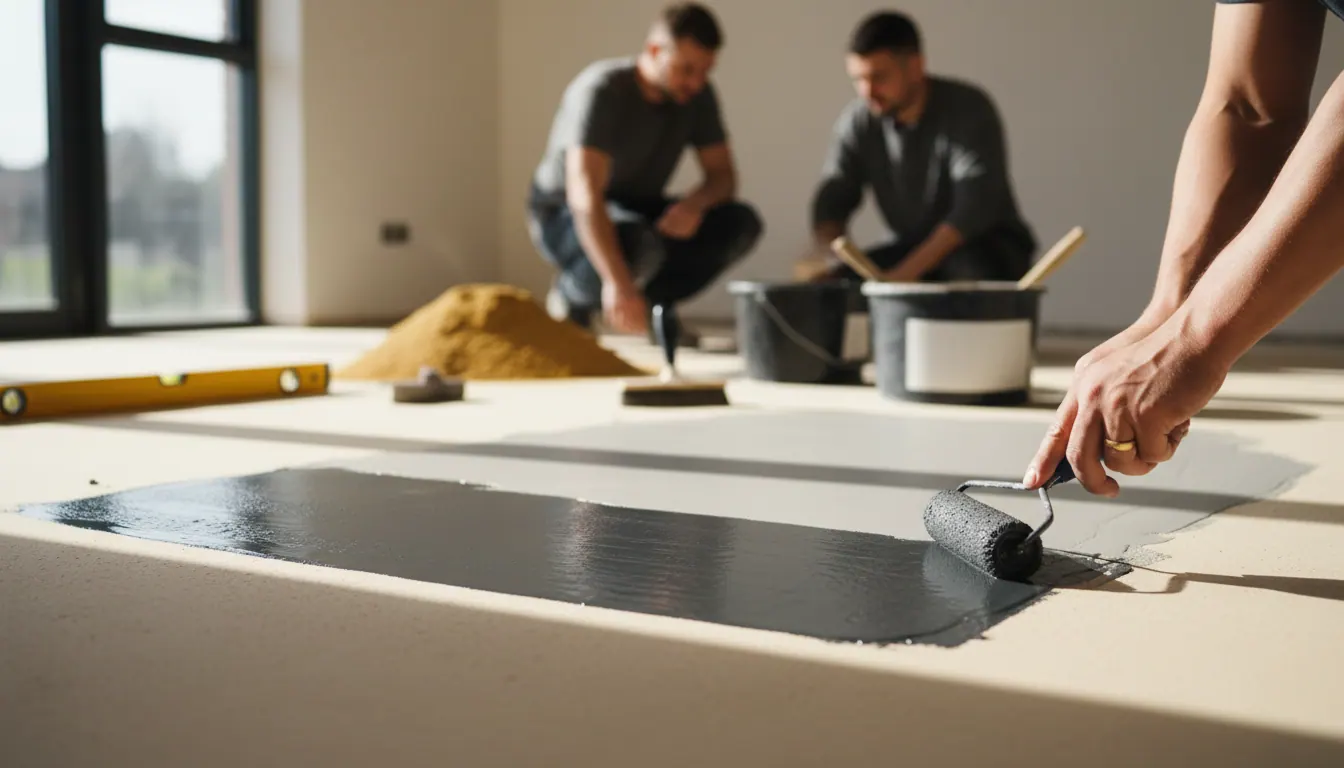
- Apply the liquid DPM. On slabs with elevated moisture readings, we apply a liquid epoxy DPM directly to the concrete. This bonds to the surface, seals it, and creates a stable base for the next step.
- Apply self-levelling compound. Once the DPM has cured, we pour and spread a latex-based self-levelling compound to bring the floor to a flat, smooth plane. LVT is thin, so even a small ridge underneath telegraphs straight through to the surface. The levelling compound eliminates that.
- Install the finish flooring. With a dry, flat, sealed subfloor, the finish floor goes down correctly and performs as it should.
Skipping or shortcutting any of those steps stores up problems. We have seen floors fail because a levelling compound was poured straight onto a damp slab without a DPM underneath it, causing the compound itself to delaminate.
For a deeper look at how this all fits together, our article on subfloor preparation for flooring in Newark: why DPM, levelling and screeding matter covers the full process in detail.
What our customers experience when we get this right
Ian Coddington left us this review after we completed a full bungalow project that included DPM, self-levelling and herringbone LVT throughout:
"Excellent, helpful, knowledgeable, hardworking guy. Nathan and his team went above and beyond for us and our project. They laid the DPM, self leveling and the flooring we requested. We chose 3 different coloured flooring for the whole bungalow and it was laid in a herring bone pattern throughout. We would definitely recommend them and already thinking of other family members and friends who would need some new flooring. Very reasonable price too. 5+* treatment for an average price. Thank you so much"
Ian's project is a good example of what proper preparation makes possible. A whole bungalow, three different floor colours, all in herringbone, finished cleanly because the subfloor work was done properly first. The DPM and levelling are not glamorous, but they are what the finished floor stands on.
If you are planning a similar project and want to understand how herringbone LVT works across multiple rooms, our guide to herringbone LVT flooring in the East Midlands: design, durability and installation is worth a read.
Frequently asked questions about damp proof membrane floors
Do I need a damp proof membrane under laminate flooring? On a concrete ground floor, yes. Most laminate warranties require it, and without one, moisture vapour from the slab can degrade the underlay and cause the boards to swell and lift over time. On a timber suspended floor, the need is less common, but the subfloor condition still needs assessing.
Can I install a damp proof membrane over a concrete floor? Absolutely. Both sheet and liquid DPMs are designed specifically for concrete application. A liquid epoxy DPM bonds directly to the slab and is particularly effective where a levelling compound will be applied on top, because it creates a sealed, bondable surface. Sheet DPM works well for floating floors where a direct bond to the concrete is not required.
What is the best liquid damp proof membrane for flooring? The best product depends on the moisture reading of the slab and what is going on top of it. For high-moisture slabs or where a levelling compound will be bonded directly, a two-part epoxy DPM is the most reliable choice. It is more expensive than a single-coat product, but it handles higher levels of residual construction moisture and creates a stronger bond. We specify products based on the actual site conditions rather than a one-size-fits-all approach.
Do damp proof membranes work? Yes, when installed correctly. A properly lapped and sealed sheet DPM or a correctly applied liquid DPM will block moisture vapour effectively and protect the flooring above it for the life of the floor. The failures we see are almost always installation errors: inadequate laps, insufficient coats of liquid DPM, or application over a poorly prepared surface. Professional installation makes the difference.
Ready to sort your subfloor before the new floor goes down?
If you are planning new flooring in Newark-on-Trent or anywhere across the East Midlands and you are not sure whether your subfloor needs a DPM, levelling or both, we can come out, take a look and give you a clear, honest assessment. No obligation, no pressure.
Get in touch with us to book your free home measure and we will bring samples too.