Underlay for Stairs: Choosing the Right Thickness, Density & Material for Safety & Comfort
Choosing the right underlay for stairs protects your carpet and keeps it looking great for years. Pro Flooring explains what works and what to avoid.

Underlay for stairs is not the same as underlay for a flat floor
Most people give underlay about thirty seconds of thought. They pick whatever the carpet shop recommends, or grab whatever is cheapest, and move on. On a flat living room floor, that approach rarely causes obvious problems. On stairs, it causes real ones.
Stairs take concentrated, repeated impact in exactly the same spot every single time someone uses them. The nose of each tread (the front edge where your foot lands) bears the brunt. Get the underlay wrong and the carpet wears through at the nose, bubbles between the grippers, or compresses so fast it feels threadbare within a couple of years. Get it right and your carpet performs the way it should, stays in place, and keeps looking good for years.
We fit a lot of stair carpet across Newark-on-Trent and the wider East Midlands, and the underlay conversation comes up on almost every job. Here is what we have learned.
Do you actually need underlay on stairs?
Yes. Full stop. Fitting carpet on stairs without underlay is a false economy. Underlay cushions the impact at the nose, reduces the friction between the carpet backing and the hard tread, and adds enough insulation to reduce that hollow, echoey sound on timber stairs. Without it, the carpet backing grinds directly against the tread on every step, and the wear rate is noticeably faster.
The only partial exception is very thin, pre-backed carpet that comes with an integral cushion layer. Even then, a separate underlay usually improves the result.
What type of underlay works best on stairs?
The key specification for stair underlay is density, not thickness. This is where a lot of buyers go wrong.
On a flat floor, a thicker, softer underlay can feel luxurious underfoot. On stairs, excess thickness creates problems:
- The carpet nose can overhang or pull away from the gripper rod
- Thick underlay compresses unevenly under the specific load pattern of a stair tread
- It can make the stair feel unstable, particularly on narrow or steep flights
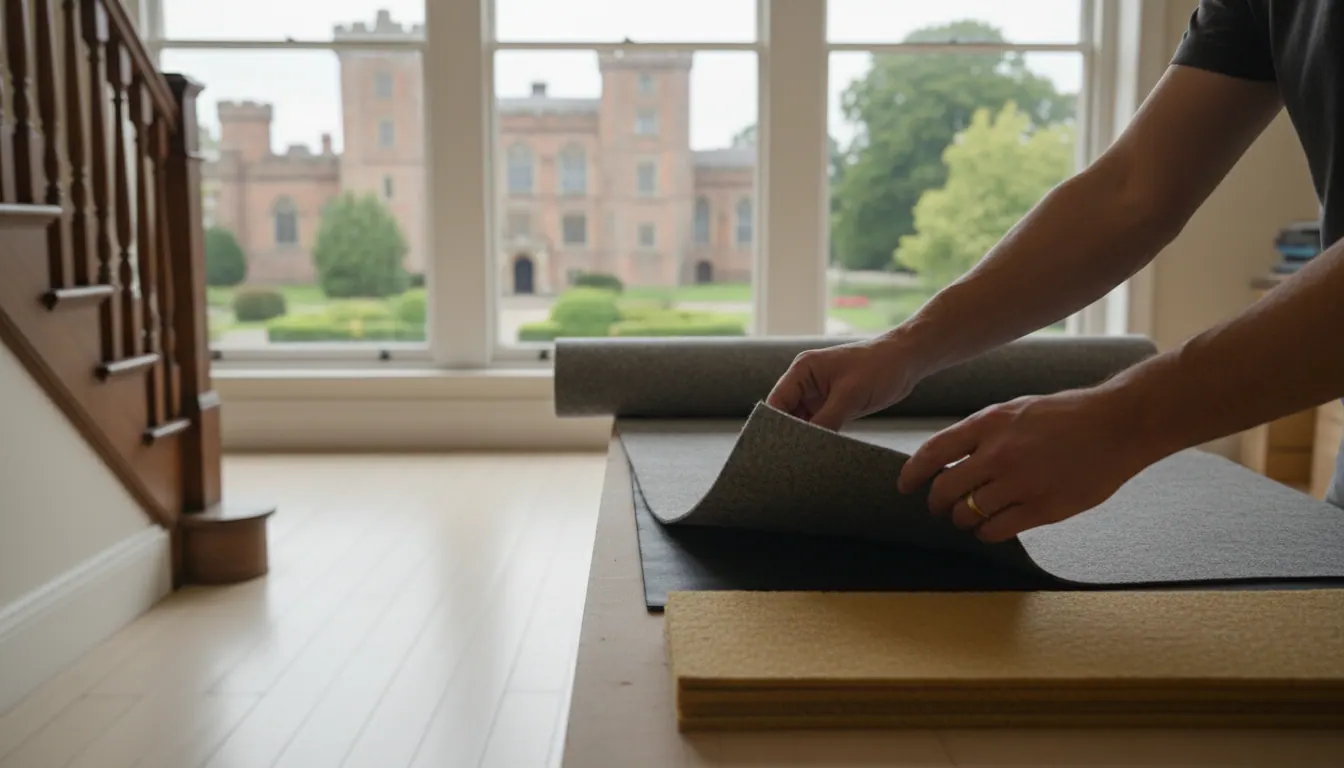
What you want instead is a high-density, thinner underlay (typically 7–8mm or less) with a firm feel. Crumb rubber underlay is a solid choice for stairs for exactly this reason: it is dense, resilient, and does not compress down to nothing under repeated point loading. A good quality PU (polyurethane) foam underlay at a higher density rating also works well.
The density rating to look for is around 130–160 kg/m³ as a minimum for a stair application. Anything lighter will feel fine on day one and noticeably softer within six months.
What type of carpet wears best on stairs?
The underlay question and the carpet question are connected, so it is worth covering both together.
For stairs, you want:
- A twist pile or loop pile carpet with a dense, low to medium pile height. Longer, looser pile flattens quickly on treads.
- A wool or wool-blend yarn, or a high-quality synthetic with good abrasion resistance. The nose of a stair tread is brutal on softer fibres.
- A carpet with a firm, stable backing. Jute-backed carpets can stretch over time; action-backed or hessian-backed carpets tend to hold their shape better under stair gripper systems.
Avoid very thick, shaggy or deep-pile carpets on stairs. They look appealing in a showroom but are harder to fit cleanly around the nose, difficult to keep clean in a high-traffic spot, and tend to compress unevenly.
What to avoid when buying carpet for stairs
Beyond pile depth, there are a few other things worth knowing before you buy:
Avoid buying carpet without seeing it in your own light. We bring samples to the house for exactly this reason. A carpet that looks warm and neutral in a shop can read very differently in a north-facing hallway or on a dark staircase.
Avoid matching the stair carpet exactly to a different room if they are on separate floors. Carpet dye lots can vary between batches. If you are fitting stairs and a landing, buy from the same batch.
Avoid going too light in colour. Stairs are a high-traffic, high-dirt area, particularly in family homes. A mid-tone or patterned carpet will hide the inevitable marks far better than a pale one.
Avoid skimping on gripper rods. The underlay and carpet are only as good as the fixing system holding them. Gripper rods on stairs need to be correctly positioned at both the riser and the tread, and they need to be nailed or glued down securely. This is a fitting issue, not just a product issue.
Sara Johnson, who had carpet fitted with us recently, put it simply:
"Absolutely amazing service from Pro Flooring! From start to finish, the service was professional, friendly and reliable. The carpet is fantastic quality and the fitting was completed to an excellent standard. I'm really pleased with the finished result and would highly recommend to anyone looking for quality carpets and a professional fitting service."
That word "standard" matters. A good carpet fitted badly will fail early. The right underlay, the right carpet, and a properly fitted gripper system work together as a system.
Can you reuse underlay on stairs?
Honestly, it is rarely worth it. Underlay compresses with use, and once it has been fitted, lifted and refitted, it will not sit as evenly. On a flat floor, reusing underlay in good condition is sometimes reasonable. On stairs, where the underlay is cut into small sections and shaped around nosings, the effort of reusing it rarely justifies the result. If you are replacing the carpet, replace the underlay too.
Does the subfloor type change what underlay you need?
Yes. Timber stairs and concrete stairs behave differently, and the underlay choice should reflect that.
On timber stairs, the main concerns are movement, squeaking, and the nail pattern from the gripper rods. A firm underlay with good grip on both faces reduces movement and helps the carpet stay put.
Concrete stairs are less common in domestic properties across Nottinghamshire and Lincolnshire, but they do appear in flats, older terraces with solid ground floors that extend to internal stairs, and some commercial conversions. On a hard concrete substrate, a slightly denser underlay with a thin profile works best. There is no flex in the substrate, so the underlay needs to provide all of the cushioning without adding so much height that it interferes with the nosing profile.
If the stairs are part of a wider renovation, particularly in one of the older Victorian or Edwardian properties common across Newark and the surrounding villages, it is worth checking the condition of the treads themselves before fitting. Loose treads, squeaking risers or uneven nosings should be addressed before the carpet goes down. We always check this as part of our site visit.
For more detail on how subfloor condition affects the finished result, our article on subfloor preparation for flooring in Newark covers the principles well, even though it focuses on flat floors.
What about laminate or LVT on stairs?
We get asked this regularly. Laminate on stairs is possible but requires specific stair-nose profiles and a very stable substrate. Standard laminate underlay (the thin foam roll) is not appropriate for stairs: it is too soft and compressible to support a rigid click-lock plank under foot traffic.
LVT on stairs is a different matter. Glue-down LVT can work well on stairs when the tread surface is correctly prepared and the right stair-nose profiles are used. It is durable, easy to clean, and suits the same design language if you are running LVT through the hallway and landing. If you are considering LVT through a hallway-to-stairs-to-landing run, our article on LVT flooring installation in Newark explains why the fitting method matters as much as the product choice.
That said, carpet remains the most practical and most commonly requested option for stairs in family homes. It is quieter, warmer underfoot, and more forgiving on a stair profile that is not perfectly square.
Frequently asked questions about underlay for stairs
Do you need underlay on stairs, or can you fit carpet directly? You need underlay. Fitting carpet directly onto a hard tread without underlay accelerates wear, increases noise, and reduces comfort underfoot. The underlay also helps the carpet grip the tread correctly when used with a proper gripper rod system.
What thickness of underlay is best for stairs? Thinner and denser is better than thick and soft. Around 7–8mm at a high density (130 kg/m³ or above) is a reliable guide. Thick, soft underlay causes the carpet to compress unevenly and can pull away from the nosing.
What type of carpet holds up best on stairs? A dense, low to medium pile carpet in a twist or loop construction, ideally with a wool or wool-blend content, or a high-quality synthetic. Avoid deep-pile or shaggy carpets, which flatten quickly and are harder to fit cleanly on a stair profile.
Can the same underlay be used on stairs and landings? You can use the same product type, but the stair sections should be cut and fitted individually to each tread rather than run as a continuous sheet. On a landing, the underlay can be laid flat in the normal way. The key is that the stair sections are secured correctly so they do not shift.
Ready to sort your stair carpet?
We visit homes across Newark-on-Trent, Nottinghamshire, Lincolnshire and Leicestershire, bring samples with us, and quote each job individually once we understand what is needed. There is no obligation and no guesswork. Get in touch with us to arrange a visit.
“Just had some LVT Heringbone flooring fitted by Nathan & team. I’m blown away by how beautiful it looks. The price was very good for the quality too. I shall be getting them to do my carpets next. Thank you”