Acclimatising Wood Flooring Before Installation: Why It Matters in East Midlands Homes
Why acclimatising wood flooring before installation matters, how long it takes, and what goes wrong if you skip it, practical advice from Pro Flooring.

Why acclimatising wood flooring is the step that makes or breaks the job
Solid and engineered wood flooring moves. That is not a flaw, it is simply what timber does when the humidity and temperature around it changes. If you lay a floor before the boards have had a chance to adjust to the conditions inside your home, you are asking for trouble: gaps in dry weather, cupping or buckling when things warm up, and fixings that work loose over time. Acclimatisation is the process of letting the boards settle to the ambient moisture content of the room before a single one is fixed in place.
It sounds simple. In practice, it is one of the most frequently skipped steps, and one of the most common reasons we get called in to diagnose a floor that has gone wrong.
Does engineered wood flooring need to acclimate?
Yes. Engineered wood flooring absolutely needs to acclimatise, even though it is more dimensionally stable than solid hardwood. The cross-ply construction reduces movement significantly, but the real-wood top layer still responds to moisture. If the boards arrive from a cold warehouse or a delivery vehicle and go straight down onto a warm subfloor, the wood will continue to expand and contract after installation rather than before it.
Solid hardwood is even more sensitive. A board that looks perfectly flat in a cold van can behave very differently once it has been in a centrally heated room for a week. Acclimatising solid hardwood properly is not optional, it is the difference between a floor that lasts decades and one that starts failing within months.
Laminate is less demanding than real wood, but it still benefits from a settling period. The inner core is usually HDF, which does absorb moisture to some degree. Twenty-four hours is often quoted, but in a room with underfloor heating or unusual humidity, longer is better.
How long should engineered wood flooring acclimatise before installation?
The honest answer is: it depends on the gap between where the wood has come from and the conditions in your home.
As a working rule, most engineered hardwood flooring needs a minimum of 48 to 72 hours in the room where it will be laid. Solid hardwood typically needs longer, often five to seven days, sometimes more. The boards should be stacked or spread in the actual room, not a hallway or garage, because conditions vary significantly from room to room.
What matters is not just time, it is equilibrium. A moisture meter is the only way to know for certain that the boards have reached a stable moisture content that matches the subfloor. We use one on every hardwood job. Without it, you are guessing.
Factors that affect how long acclimatisation takes:
- The season. Winter deliveries into a heated home, or summer deliveries during a humid spell, both create bigger differentials to bridge.
- The subfloor type. A concrete slab retains more moisture than a timber sub-floor, and that moisture can continue to affect boards after installation if the subfloor has not been properly prepared. Our article on damp proof membranes and floor levelling in older properties explains why subfloor moisture testing matters before any wood goes down.
- Whether underfloor heating is present. UFH dries the air and the subfloor. Boards need to acclimatise with the heating running at the normal operating temperature, not switched off to be kind to the wood.
- The room's normal use. A kitchen or utility room has more ambient humidity than a bedroom. That changes the target moisture content the boards need to reach.
Can hardwood flooring acclimatise in the box?
This is a common question, and the answer is no, or at best, only very slowly. Cardboard packaging restricts airflow around the boards. The moisture content of the wood at the centre of a tightly sealed pack can take far longer to equalise than the outer boards, meaning you end up with uneven acclimatisation across the batch.
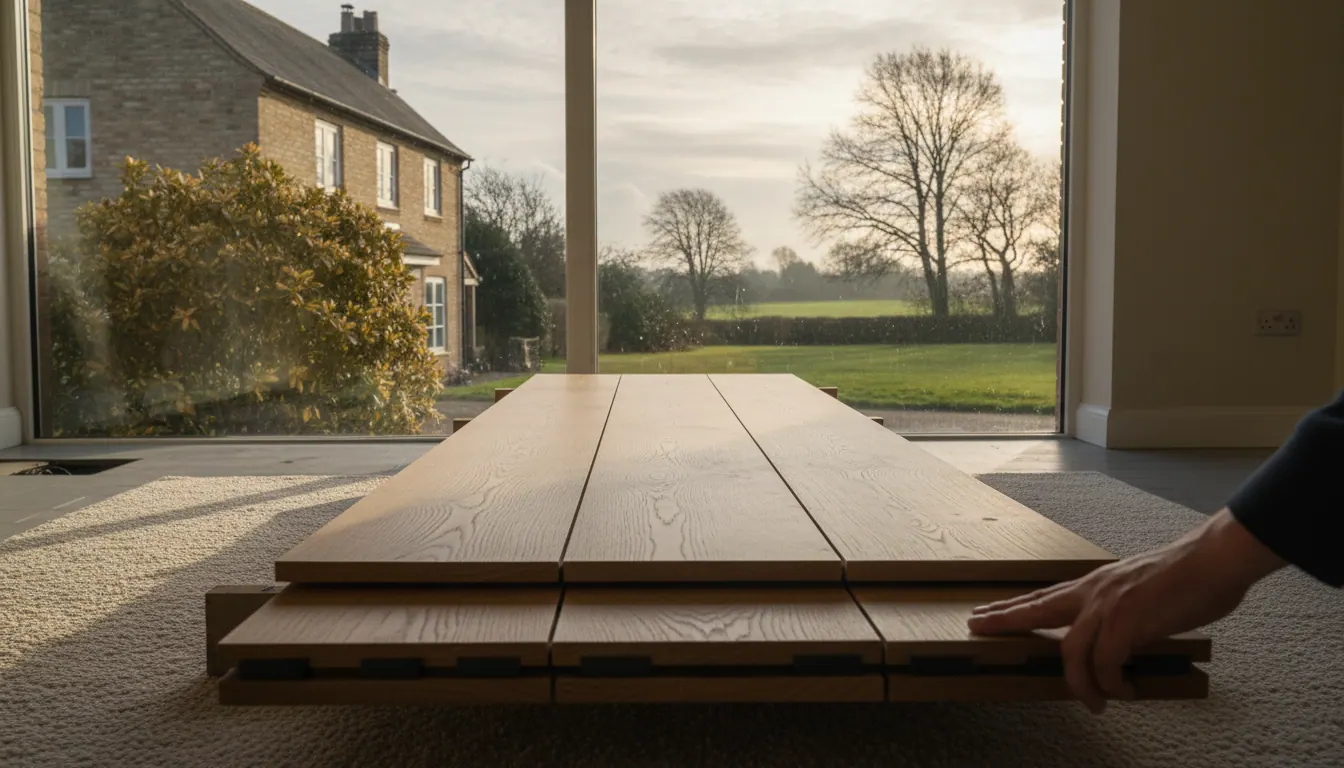
The right approach is to open the packaging and either stack the boards with spacers between layers to allow air to circulate, or lay them flat in a single layer if space allows. Either method is significantly more effective than leaving them in the box.
What is the Rule of 3 for flooring?
The Rule of 3 is a practical guideline sometimes used in the trade: three days of acclimatisation, three days after installation before heavy use, and checking at three key points, the delivered moisture content, the subfloor moisture content, and the room's relative humidity. It is a useful memory aid rather than a precise technical standard, but the underlying principle is sound. Rushing any of these stages is where problems begin.
East Midlands conditions: why local climate matters
The East Midlands sits in a part of England with a reasonably continental climate by UK standards, colder winters, drier summers and meaningful seasonal swings in indoor humidity. Older housing stock across Nottinghamshire, Lincolnshire and Leicestershire tends to have solid masonry construction that retains moisture differently from newer cavity-wall builds. Many homes in the region also have suspended timber ground floors over unventilated voids, which can contribute to elevated moisture levels at subfloor level.
For anyone fitting engineered or solid hardwood in a period terraced property in Newark or an older Victorian semi in Lincoln or Grantham, the subfloor moisture picture is often more complicated than in a modern new-build. That is not a reason to avoid wood flooring, it is a reason to test properly before you start, and to be realistic about acclimatisation time.
What our customers notice when it is done right
Stuart came to us unsure of exactly what he wanted. We brought samples to the house, explained the process, and took the time to match the right product to the right room.
"From the first meeting with Pro flooring we have been very happy with the service we recieved. We weren't sure what flooring we wanted but Nathan was brilliant and helped us by showing lots of samples and explaining the process to us. He turned up on time to do the job and we are very happy with his work. We would recommend him and Pro Flooring to friends and family."
, Stuart Millard
That process, understanding the room, the subfloor, the heating and the intended use before any product is ordered, is exactly why acclimatisation gets handled properly on every job we do. It is not a box-ticking exercise; it is how you protect a significant investment in your home.
If you are also weighing up whether engineered hardwood is the right choice for your space, our comparison of LVT vs laminate for Newark homes covers the key differences in a practical way.
What are the downsides of engineered wood flooring?
Engineered hardwood is an excellent product, but it is worth being clear-eyed about its limitations:
- It still moves. Less than solid wood, but it is not dimensionally inert like LVT. Acclimatisation and a well-prepared subfloor are non-negotiable.
- The wear layer can only be sanded a limited number of times. Thicker wear layers give you more scope, but this is not a floor you can refinish indefinitely.
- It does not suit every subfloor. High residual moisture in a concrete slab, or a poorly levelled subfloor, will cause problems regardless of the product's quality. Surface preparation matters enormously.
- It needs a stable environment. Rooms with extreme temperature swings or persistent humidity (bathrooms, some conservatories) are not ideal candidates without careful specification.
None of these are dealbreakers, they are just the reasons why the right advice, the right preparation and the right installation method matter.
Frequently asked questions
Does engineered wood flooring need to acclimate before it is laid? Yes. Even though engineered hardwood is more stable than solid wood, the real-wood surface layer still responds to changes in temperature and humidity. Skipping acclimatisation risks movement, gapping or cupping after installation. Allow at least 48 to 72 hours in the room where the floor will be fitted, with the packaging open and airflow around the boards.
How long should engineered wood flooring acclimatise before installation? A minimum of 48 to 72 hours is a reasonable starting point for most engineered products in typical UK domestic conditions. Solid hardwood usually needs five to seven days or more. The most reliable indicator is moisture meter readings showing that the boards have reached the same moisture content as the subfloor and the room, time alone is not enough.
Can hardwood flooring acclimatise in the box? Not effectively. Sealed packaging restricts airflow and slows the process significantly. Open the boxes, stack the boards with spacers between layers or lay them flat, and allow air to circulate around them in the actual room where they will be fitted.
What is the best time of year to have wood flooring fitted? Spring and autumn tend to offer the most stable indoor conditions in the East Midlands, when heating is not running at full capacity and humidity levels are moderate. That said, a good installer will acclimatise properly and moisture-test regardless of the season, so there is no month that makes it impossible, only months that make it more important to be thorough.
Get it right from the start
Acclimatisation is one part of a larger process that includes moisture testing, subfloor preparation and choosing the right product for the room. We handle all of it, and we bring samples to you so you can see how a floor will look in your own light before anything is ordered.
If you are planning a hardwood or engineered floor in Newark, Nottinghamshire, Lincolnshire or Leicestershire, get in touch with us and we will come to you, measure up and talk through exactly what the job involves.
“Nathan at Pro Flooring is excellent. I would highly recommend! He has fitted a beautiful floor, very quickly and for a great price. More importantly for me as a wheelchair user, he gave me great advice that made sure I selected the most appropriate product. Without his advice I was about to make a c…”